
Red Headed Krait (Bungarus flaviceps)
[Last update: 14 June 2023]
Red Headed Krait – Venomous Snake
Thais say: Ngoo sam lee-um hoo-uh si dang
Length: These kraits grow to about 2 meters long, though most adults found are shorter.
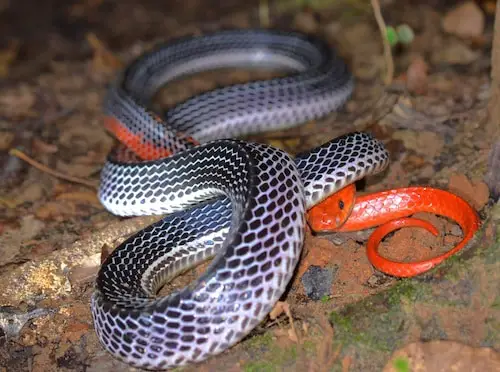
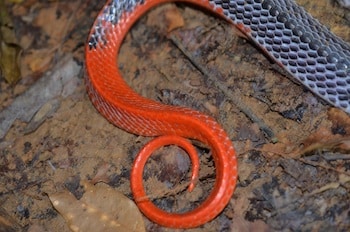
Appearance: Somewhat pronounced vertebral ridge, which differentiates from the Malayan Blue Coral Snake (Calliophis bivurgata). Body is black or dark grey, and the head and tail are bright red or orange. The tail on the venter is also the same color. The rest of the venter is creme to white-colored. The head is more distinct from the neck than C. bivirgata. Dorsal scale count: 13-13-13.
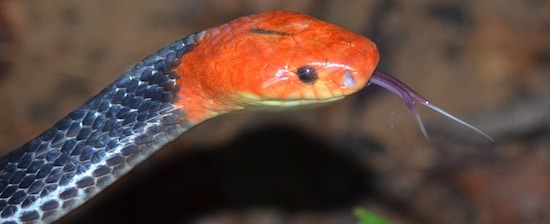
Range: In Thailand, the Red-headed Krait is only found in the southern Thailand provinces from Ratchaburi and southward. Across the globe, they are most heavily concentrated in Malaysia, Borneo, and a couple of other places.
Recently I found a large 1.9 to 2-meter specimen in the rainforest in Trang province. I have also found them in Surat Thani, and Krabi provinces.
Habitat: Lowlands and hilly rainforest-type habitat. The last four of these snakes I saw were all found at less than 200 meters elevation. One was found around 1200 meters elevation in Krabi by hikers camping at the top of Khao Phanom mountain.
Active Time? Probably active both at night and day. Three of five of these snakes in our local area were found during the daylight.
Food: Some say the red-headed kraits eat more frogs, lizards, eggs, and rodents than other snakes. Probably they are opportunistic and eat whatever presents itself. Kraits eat other snakes as well.
Defensive Behavior: Of the four snakes examined – none struck out, none attempted to bite at all. Note – all but one was handled during daylight hours.
Venom Toxicity: Venomous, and deadly. The venom has been shown to have an LD50 subcutaneous measurement of .35 mg/kg for Bungarus flaviceps, while Bungarus candidus (Malayan Krait) was .32 mg/kg, and Bungarus fasciatus (Banded Krait), .62 mg/kg and less than that in another study.
This makes it one of the top venomous snakes on the planet and within the top three most venomous in Thailand. The black mamba is listed at the same .32 mg/kg by a well-known venom researcher at his site. (well, now he pulled down his chart). Only 10 other terrestrial snakes in the world were listed with more potent venom.
Little is known of this venom’s effect on humans after a bite, though it is likely very similar to a bite from Bungarus candidus, I could find no treatment studies due to bites being quite rare by this krait species.
From the abstract of a recent (2/2010) venom study in Malaysia: Bungarus flaviceps (red-headed krait) venom presents an intravenous LD50 of 0.32 μg/g and exhibits enzymatic activities similar to other Bungarus toxins.
ELISA cross-reactions between anti-Bungarus flaviceps and a variety of elapid and viperid venoms were observed in the current study. Double-sandwich ELISA was highly specific, since anti- B. flaviceps serum did not cross-react with any tested venom, indicating that this assay can be used for species diagnosis in B. flaviceps bites. In the indirect ELISA, anti- B. flaviceps serum cross-reacted moderately with three different Bungarus venoms (9-18%) and Notechis scutatus venom, but minimally with other elapid and viperid toxins. The results indicated that B. flaviceps venom shares common epitopes with other Bungarus species as well as with N. scutatus. The lethality of the B. flaviceps venom was neutralized effectively by antiserum prepared against B. candidus and B. flaviceps toxins and a commercial bivalent elapid antivenom prepared against B. multicinctus and Naja naja atra venoms, but was not neutralized by commercial antivenoms prepared against Thai cobra, king cobra and banded krait. These data also suggested that the major lethal toxins of B. flaviceps venom are similar to those found in B. multicinctus and B. candidus venoms.
Treatment Summary: Envenomation can produce moderate to severe flaccid paralysis, and respiratory failure requiring intubation and ventilation in severe cases. Antivenom available for major species (detailed below), could potentially prevent worsening of paralysis, but may not reverse established paralysis.
Key Diagnostic Features: Minimal to mild local reaction + flaccid paralysis
Antivenom Code: SAsTRC04
Antivenom Name: Banded Krait Antivenin
Manufacturer: Science Division, Thai Red Cross Society
Phone: +66-2-252-0161 (up to 0164)
Address: Queen Saovabha Memorial Institute, 1871 Rama IV Road, Pathumwan, Bangkok 10330
Country: Thailand
Offspring: Two clutches from two adult female red-headed kraits were studied by Chulalongkorn University scientists in Bangkok. One clutch was four eggs, and the other, six eggs. After 81-84 days in incubation at 26-27C and the other clutch at 30-32°C eggs hatched.
Fewer eggs hatched at the higher temperature incubation. The average hatchling length was 28.9cm +/- .8cm measured from snout to vent. The weight of each was 7.2 to 7.8 grams. Humidity in the incubation enclosures was 60-70%. After 7-10 days all snakes had shed.
Notes: I have seen five of these kraits, and they are quite incredible to find in the wild considering how rare they are.
Bungarus flaviceps has not been studied very well, and I suspect that most of the information on Wikipedia and other information sources has been generalized from other Thailand kraits like the Blue Krait (Bungarus candidus) and Many Banded Krait (Bungarus multicinctus) because the wording seems too similar to be by chance.
There are a number of Malayan Blue Coral snakes misidentified on Youtube videos, and on Wikipedia.
These snakes have not been studied well in captivity or in the wild, except for the previously mentioned study in which the kraits lived surprisingly long. Usually, the literature shows the red-headed krait dies quickly in captivity.
These kraits are not known to bite during the daytime, but, be exceptionally careful when handling them.
Substrate: Best? Leaves and something large to hide underwood is best, rocks, something solid. They are typically found close to a freshwater stream in primary forest with rocks around.
Ways to differentiate Bungarus flaviceps from the Malayan Blue Coral Snake (Calliophis bivirgatus): #
1. B. flaviceps has a triangle cross-section, while C. bivirgatus has more of a round cross-section.
2. C. bivirgatus has a venter that is all red – orange. B. flaviceps has red under the head and tail only.
3. B. flaviceps reaches about 2 meters while B. bivirgatus grows to just 1.7 meters.
4. B. bivirgatus has lateral lines on both sides of the body toward the venter, which are solid light blue or white.
5. By studying some video one can see how their crawling pattern differs.
6. B. flaviceps has a more sizable head, a wider head, and larger mouth than the coral snake.
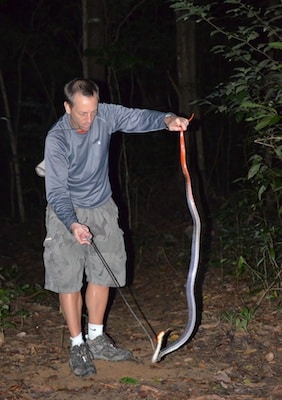
Update. At 11:30 pm in a Thailand National Park in Trang Province, a friend and I found a large 1.9+ meter long Bungarus flaviceps on the trail and photographed and shot video of it. Video #1 is of this snake. The photos on this page are all of the same snake. As with all snakes found, it was released in the same spot as where it was found.
Similarity to Other Kraits? #
None really. The Banded Krait is yellow and black striped with a similar body cross-section like a triangle. This is common to snake-eaters. The tail is quite different, with the banded krait having a knob of a tail, not slender and tapered like the red-headed krait.
Red-headed Krait Scientific Classification #
Kingdom: Animalia
Phylum: Chordata
Subphylum: Vertebrata
Class: Reptilia
Order: Squamata
Suborder: Serpentes
Family: Elapidae
Genus: Bungarus
Species: Bungarus flaviceps
Binomial name: Bungarus flaviceps
Classified by Reinhardt, in year, 1843
Photos of Bungarus flaviceps #
Video – Large Red-Headed Krait caught in Trang Province, Southern Thailand: #

Video – Red Headed Krait – Bungarus flaviceps caught in Southern Thailand: #

Part 2 of Red Headed Krait Video: #

Did you get our FREE PDF file yet?
PHOTOS OF COMMON THAILAND SNAKES!
It’s HERE>
- 83 pages
- many snakes featured: Cobras, Kraits, Pit Vipers, Corals, Rat Snakes, etc.
- facts and photos!
I recently caught a red headed krait snake in Pai, Mae Hong Son Thailand (north). I released it after cature and have seen it 3 times in the last 5 months. I also caught a white spitting Cobra and yesterday caught a red neck keelback.
Send pictures!
Marcus:
We’ve chatted before and I lived in Satun for a while where I enjoyed snake watching. The most common was Ngu Kappa Samblium, or the Malayan Pit Viper as we all know. But my girlfriend Ping told me of a snake named Ngu Gappa Fai. I had thought it was the red necked keelback but I guess not. Have you or your wife heard of this snake? Ping never really explained how it looked and several Thais had heard of it but didn’t know how it looked.
Moke
You know, I never listen to what Thais say about snakes. I just disregard everything. I’ve heard so much nonsense, and very little fact about any of them. What one calls Ngu Sam Liam, someone else calls something different. There are VERY FEW Thais educated about snake species in the country. There are some, but unless I hear from one of the guys I know, it goes in one ear and out the other. :)
Thanks for the reply Marcus. I am in total agreement but still believe there is a Ngu Gappa Fai, Yet it may be an old term that is not used now. I guessed that Fai means electricity and a snake with red or yellow around the head, plus venom might be it.
I any case I think Thais are not experts on snakes except for having lived with them and knowing people who have been bitten and killed. One teacher sent me a picture of a Blue Krait in her yard and told me it was a Ngu Prong Tong ( Mangrove Cat Snake ). A second teacher told me an Oriental Whip Snake I took a picture of was a very venomous one and if bitten on a finger it must be cut off. My learning comes from internet research while theirs comes from stories meant to keep them safe. Though I feel sorry for the snakes I can’t blaming the Thais for wanting to kill them all due to fear.
Moke
Yeah, i get why Thais kill everything. There are 200+ species of snake in their country, there are few that can know what all is dangerous and what isn’t. The problem isn’t people killing tree snakes at their house, it’s the Thais that hunt and sell king cobras and other snakes. In a couple years there will be VERY few king cobras in the wild. Even just here in Krabi, I’ve seen hundreds come and go to sale to bkk for Chinese to eat, well, and probably Thais too.
I must say Marcus that the YouTube you made of the King Cobra that leaped up the tree root to tower over your friend was scary. Nevertheless I would like to see one in the wild. I spoke to a Vietnamese guy who told me as a kid there were lots of snakes but now not so many. That’s sad because they were killed by people. Here in Canada the fur trade is almost dead. 30 years ago a trapper could get $600.00 for a lynx but today they get only $100.00 The reason is that the world has turned against fur. So the animals can survive trapping. My delight in Satun was to see so many snakes, both alive and dead on the roads around rubber plantations. There may be hope.
Moke
Marcus, my friend in Satun said she had Ngu Dang at her home. What do you think it was? I saw a few red necked keel backs there but never anything else with red.
Moke
The Boiga nigriceps is down that way. There is the Blue Coral Snake – which has a red head in addition to Bungarus flaviceps. But they have obvious blue/black mid bodies between the red heads and tails. There is an Oligodon that is orange or maybe another shade. Google Oligodon cinereus with image search. Some of those look reddish.
Thanks Marcus. It could be any of them I guess. The red cat snake might be called Ngu Dang by some I suspect. I’ll need to ask her which parts were red. She’s really used to snakes I’m sure because Satun is quite wild in terms of vegetation.
Moke
Oh yeah, Satun has a LOT of snakes!
Thanks for this information. Last week I was visiting Railay Beach in Krabi. Was walking from west to east beach when I spotted a snake. It was about 45cm in length with a very distinct bright red head & upper body. It had just caught a live, moving frog. Now doing my research I suspect it’s a krait & is poisonous & a rare find! Coming from SE Australia this surprised me.
Maybe. I think more likely it was either a Rhabdophis subminiatus (red-necked keelback) or a triangle keelback. Cheers!
I am moving to Thailand in a month. I am planning to buy me a set of snake gaiter chaps as where we will live is near a mountain about 45 minutes driving from Korat. I was bit by a rattle snake in Southern Oregon USA as a kid and lived to tell about it thanks to my grandpa seeing it happen and taking immediate action with snake bite kit and first aid. I soon discovered I am severely alergic to the Horse Serum used in the anti-venom at the hospital. I must say, having a healthy respect for all poisonous snakes is just smart!
I live in Khaem Son Khao Kho District Phetchabun. A red headed crate was caught by a neighbor a few months ago. They didn’t know what it was but thanks to this site I was able to identify it. Today, about 20 minutes ago, my cat was doing her usual hunting thing. She hunts rats, frogs, birds, lizards. I watched her because she looked like she was going to bounce and then I saw the Kraite pop up. It was red headed with the identical yellow green color body shown in the video. EXACTLY the same but appeared a bit smaller.
Hi Tony, I’m not sure what you saw, but the red-headed krait has no yellow green body color at all. Just blackish with red head and red tail.