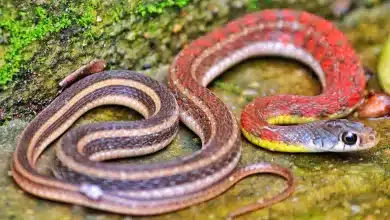
A couple months back I received an email from a concerned father whose son was bitten by a red-necked keelback (Rhabdophis subminiatus) he had found in their neighbor’s garden.
“My son is suffering from non clotting, severe swelling, and paralysis and is now in ICU, where his vital and neuro signs are ok, but blood not good.”
These snakes have, in the past, not been identified as a dangerous snake. Many people have them as pets, and free-handle them with bare hands. Sometimes these snakes bite, but once they are handled a bit they usually calm down and rarely bite. There have been some cases in the literature where bites have resulted in hospitalization, and there has been a push to identify these snakes as what they are – venomous, and dangerous.
Colubrids, rear-fanged snakes, are nearly all venomous. Venom is modified saliva that helps the snake kill and break down the body of their chosen food.
I was excited to have a response from the father of this boy that spent 2 weeks in a Thailand hospital after suffering 2 bites from this snake.
Here’s what I learned after some questions by email…
1. Can you tell anything about how the bite occurred? Was the snake typically calm – and then, out of the ordinary behavior – it bit your son?
Calm, he was showing off to his friend’s that he can handle snakes, this was a wild one not a pet. He has a constrictor, a corn snake and a python as pets, all fairly placid, but the keelback he had no understanding of.
2. Approximately how long did the snake bite down on your son’s hand? Was it less than 1 second? 1-3 seconds? 3-5? 10? 60 or more? This is the most important question because in the past we haven’t seen enough venom transferred from quick bites, or even repetitive quick bites…
Between 30-40sec I believe, wouldn’t let go
3. Did the snake bite more than once that day?
Bit him twice within a few minutes.
4. Did the snake routinely bite your son – often?
First time.
5. Can you tell me approximately how long was the snake? Do you have any photos of it? Can you please send if you do?
No photo’s I’m afraid, he didn’t mention how long it was, but he will be back from school at the weekend, and I’ll fish more info out of him.
6. Did you get the snake in Thailand? There in Phuket, or where?
Wild snake in his friend’s garden.
*******
So, here again – the snake bit down for an extended period of time – 30+ seconds, and had time to squeeze a lot of venom into the boy’s hand.
There is no known anti-venin for the Rhabdophis subminiatus.
Venom Characteristics (from http://www.afpmb.org/content/venomous-animals-r#Rhabdophissubminiatus)
Mainly procoagulants, which can cause renal failure; plus mild neurotoxic factors. Envenomation does not always occur. Bite may be almost painless w/ minimal local swelling. Symptoms of envenomation may include local numbness, headache, nausea, & vomiting; in severe cases renal failure has caused human deaths. No known antivenom currently produced.
LD50 for intravenous injection – 1.29 mg/kg. That is extremely venomous…
This snake has no actual venom gland, but the venom resides in the saliva itself, and with a long bite – can envenomate a person, causing great harm.