Tag Archive | "red headed krait"

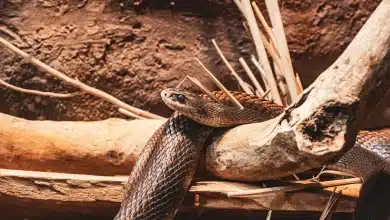
Deadly snake, the red headed krait from southern Thailand (Bungarus flaviceps)

Red Headed Krait – Bungarus flaviceps – Deadly

Deadly snake, the red headed krait from southern Thailand (Bungarus flaviceps)

Beautiful - Deadly - Rare


Red Headed Krait (Bungarus flaviceps)

Thais say: Ngoo sam lee-um hoo-uh si dang

Length: These kraits grow to just over 2 meters, though most found are under 2 meters.

Range: In Thailand the red headed krait is only found in the southern provinces from Ranong and southward. Across the globe they are most heavily concentrated in Malaysia, Borneo, and a couple other places.

Habitat: Lowlands and hilly rain forest type habitat. The last 3 of these snakes I saw were all found at at less than 200 meters elevation.

Active Time? Probably active both at night and daytime. Three of these snakes in our local area were found during the daylight. Probably they prefer the night time hours for hunting food.

Food: Some say the red headed kraits eat more frogs, lizards, eggs, and rodents than other snakes. Probably they are opportunistic and eat whatever presents itself.

Defensive Behavior: In the 3 snakes examined – none struck out, none attempted to bite at all. Note – this was all during daylight hours.

Venom Toxicity: Venomous, and deadly. The venom has been shown to have an LD50 subcutaneous measurement of .35 mg/kg for Bungarus flaviceps, while Bungarus candidus (Malayan Krait) was .32 mg/kg, and Bungarus fasciatus (Banded Krait), .62 mg/kg and less than that in another study. This makes it one of the top venomous snakes on the planet. The black mamba is listed at the same .32 mg/kg by respected venom researcher, Dr. Bryan Grieg Fry at his VenomDocs.com site. Only 10 other terrestrial snakes in the world were listed with more potent venom. Little is known of the this venom’s effect on humans after a bite, though it is likely very similar to a bite from Bungarus candidus, I could find no treatment studies due to bites being quite rare by this krait species.

From the abstract of a recent (2/2010) venom study in Malaysia: Bungarus flaviceps (red-headed krait) venom presents an intravenous LD50 of 0.32 μg/g and exhibits enzymatic activities similar to other Bungarus toxins. ELISA cross-reactions between anti-Bungarus flaviceps and a variety of elapid and viperid venoms were observed in the current study. Double-sandwich ELISA was highly specific, since anti-B. flaviceps serum did not cross-react with any tested venom, indicating that this assay can be used for species diagnosis in B. flaviceps bites. In the indirect ELISA, anti-B. flaviceps serum cross-reacted moderately with three different Bungarus venoms (9-18%) and Notechis scutatus venom, but minimally with other elapid and viperid toxins. The results indicated that B. flaviceps venom shares common epitopes with other Bungarus species as well as with N. scutatus. The lethality of the B. flaviceps venom was neutralized effectively by antiserum prepared against B. candidus and B. flaviceps toxins and a commercial bivalent elapid antivenom prepared against B. multicinctus and Naja naja atra venoms, but was not neutralized by commercial antivenoms prepared against Thai cobra, king cobra and banded krait. These data also suggested that the major lethal toxins of B. flaviceps venom are similar to those found in B. multicinctus and B. candidus venoms.

Offspring: Will add to this as I get it.

Notes: I have seen 3 of these kraits, and they are quite incredible to find in the wild considering how rare they are. The Bungarus flaviceps has not been studied very well, and I suspect that most of the information on Wikipedia and other information sources has been generalized from other Thailand kraits like the Blue Krait (Bungarus candidus) and Many Banded Krait (Bungarus multicinctus) because the wording seems too similar.

These snakes have not been studied well in captivity or in the wild. They are not known to bite during daytime, but, be exceptionally careful when handling them.

Substrate: Best? Leaves and something large to hide under – wood is best, rocks, something solid.

Bungarus flaviceps

Scientific classification
Kingdom: Animalia
Phylum: Chordata
Subphylum: Vertebrata
Class: Reptilia
Order: Squamata
Suborder: Serpentes
Family: Elapidae
Genus: Bungarus
Species: Bungarus flaviceps

Binomial name: Bungarus flaviceps

Classified by Reinhardt, in year, 1843

Video 1 – Red Headed Krait – Bungarus flaviceps caught in southern Thailand:

2nd Part of Red Headed Krait video:

Posted in front-fangedComments (2)

Red Headed Krait – Thailand Snake Journal

Red-headed Krait found while herping in Thailand

Yesterday I headed out to herp with a guy from the UK. We chose a jungle that bordered a national park for our adventure and walked around for just over an hour when we came upon a snake climbing up the side of a 5 foot wall of dirt along the path we were walking on. My friend instinctively reached out to grab the tail, I only saw the red tail – and I said loudly and quickly “DON’T TOUCH IT!”

He had seen it first. I had only seen the tail – which was enough for me to call it either a red headed krait (Bungarus flaviceps), or a Blue Coral snake – which also have red tails (Calliophis bivirgatus flaviceps). I was pretty certain I could distinguish a rather pronounced spinal column ridge. After some discussion my friend agreed and we called it a Red Headed Krait. He had seen the snake much more clearly than I did – since he looked at it for 2 seconds before deciding what to do. He said it had a bright red head and blackish/bluish body, then the long red tail that I saw as well. He estimated the length at a meter.

This is the 2nd red headed krait I’ve found in the daytime. It was on the side of a hill in the shade – at 1400 hours and bright sunshine. They are supposed to be primarily nocturnal, like the other Bungarus (Bungari), so others that have seen it have said. Still -  I have seen accounts online of these snakes being found in the daytime as well in Malaysia. I don’t think one can say these are nocturnal animals by any means. They are active by day and at night.

So, back to the story. We climbed the vertical hill and searched through very thick brush for 30 minutes to attempt to get just one more sighting to confirm what we saw, and if at all possible – catch it for some photos and videos. We never got a 2nd chance. In hindsight the krait could not have spun around quickly to bite if one of us had grabbed the tail. The front portion of his body was already in the thick brush. But, at the time there was no way to assess everything – the danger of the situation… and react to catch the snake in a safe manner.

Better to err on the side of caution – right?

But still we’re both dreaming of a lovely red-headed krait that is still running around that hill – and probably very close to where we saw it. We’re putting that spot on the “every time we come here – we check this spot” list, like we know you would too!

We did catch another snake and a VERY odd bug – both of which I’ll write about for tomorrow or in 2 days.

Here are two videos of Bungarus flaviceps – the red headed krait…

Video 1 – Red Headed Krait – Bungarus flaviceps caught in southern Thailand:

2nd Part of Red Headed Krait video:

Posted in Thailand Snake JournalComments (0)


Thailand Snakes


Welcome to Thailand Snakes…

Thailand has 200+ snake species with over 60 of them - venomous. I created this site as a way to educate Thais and visitors to Thailand about snakes. Many people kill the snakes they see in Thailand, while in many cases - they are non-venomous and completely harmless. With this site I hope to give people a better idea what is harmful and what isn't.

Browse the many snake photos and videos here so you can identify snakes you see on your porch, in your bed, or underfoot.

If you have been bitten by a snake - go to a hospital FIRST. Don't waste time looking it up on the internet. With some snakes you need to have medical help as fast as possible. With others you have some time. I know a Thai man whose brother died in less than 10 minutes from a snake bite.

There are venomous (some say 'poisonous' erroneously) snakes everywhere in Thailand. Friends have had cobras in their kitchen, and others had kraits in the garage. Vipers love bushes and trees near water and walkways.

Bookmark this site so you can quickly identify snakes you have seen. Notice the variety of venomous and non-venomous snakes in Thailand - and realize that they come in all sizes, shapes, colors, and patterns.

Email - info@thailandsnakes.com

Snake Poll – Survey – Research

What is probably eaten more by Thailand snakes than anything else?

View Results

Loading ... Loading ...

Thailand’s Deadly Snakes