
Brown Kukri Snake
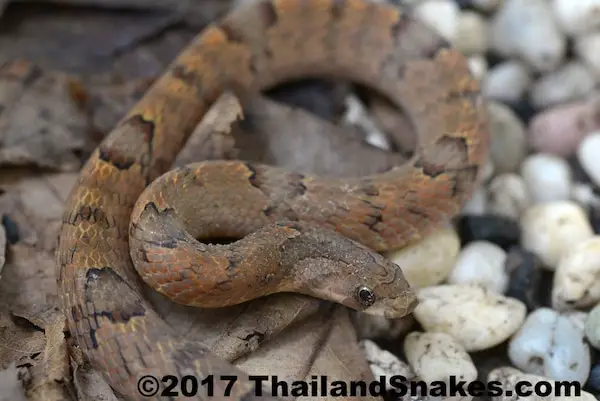
Brown Kukri Snake (Oligodon purpurascens) #
Oligodon Purpurascens, also known as the purple kukri or brown kukri, is a nonvenomous snake native to Southeast Asia. Populations can be found in Thailand, Indonesia, Malaysia and Singapore. It is also known as the brown kukri snake or purple kukri snake. This non-venomous species is native to Southeast Asia, with populations found in Thailand, Indonesia, Malaysia, and Singapore.
Although described as mainly nocturnal in the literature (Das, 2010), individuals have been observed during daylight hours. For example, the specimen basks in bright sunlight in the morning. This indicates that the species might display activity other than its usual nighttime behaviour. It could be influenced by temperature, humidity or availability of prey. The brown kukri is a fully terrestrial snake that is often found in gardens, forested areas or close to human settlements.
Morphologically, O. Purpurascens is a cylindrical, robustly built insect with a relatively short head and neck that are not very different in size. The colouration of the purpurascens is brown, but it can turn purplish with age. It has a series of evenly spaced dark brown bands with black edges and sometimes slightly wavy borders. There are also smaller, less distinct crossbars between the main bands. These give the snake an appearance of camouflage among leaf litter and forest debris.
Thais say: Ngoo koot
Appearance:
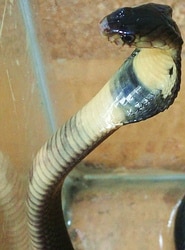
Typical kukri shape – not long, but thick snakes with a short tail and no real separation between neck and head. Very small head. The pattern on top of the head is indicative of most kukri species. Venter is cream or pink.
Length:
Average just under 1 meter (about 37 inches)
Range:
All over Thailand. Brown Kukri snakes were once thought to be native to only the southernmost Thailand provinces; however, J. Bulian has found one in Pattaya, and there have been others discovered farther in the northeast. Assume the Brown Kukri’s habitat is across most of Thailand.
Habitat:
These snakes prefer life in the forest and can be found at great elevations – about 1 mile high (1,600 meters). I have received numerous requests to identify this snake from readers who found it close to or inside their homes as well. The habitat is wide and varied for this species. Regardless of where they are found, they enjoy living under brush, wood, rocks, and thick flora.
Active Time?
Nocturnal, active at night and in the early morning as the sun rises. I have also found them in the middle of the day, and toward evening, before sunset.
Food:
The snake’s diet is diverse, consisting of frogs and other small vertebrates, such as geckos, skinks or lizards. It also eats their eggs. The snake is known to feed on birds’ eggs, especially those laid by species that nest near the forest floor or ground-nesting species.
Defensive Behaviour:
If the brown kukris are bothered enough, they will roll their body to the side and lift their tail – perhaps to present it as a place to attack – leaving the mouth free to strike when the aggressor does go for the tail. Kukri snakes have specialised egg-slicing teeth in the back of the jaw, which are enlarged and shaped like a kukri knife. When held by the head, this snake can expertly twist the jaw around to stick the handler with its teeth. Holding is not recommended.
Venom Toxicity:
No venom.
Offspring:
Lay 6-12 eggs. A reader reported his snake had 8 eggs the first time and 10 the next. Eggs hatched after 60 days, incubated at 29 degrees C. Hatching in Bangkok latitude around late April.
Notes:
Though this snake is not venomous, it is keen to bite and can inflict deep wounds due to its large, curved teeth and strong bite. Michael Cota, researcher, says, “It appears that it might be an evolutionary link on the way to being venomous, since it is the only snake that I can think of that has ‘fangs’ (enlarged pair of teeth), but no venom delivery system or ducts to the teeth. They are not dangerous, but will give you quite a bloody bite that takes a long time to heal. What makes them so difficult is that their head is not distinct; therefore, it is extremely difficult to grab behind the head and keep proper control of it. It maneuvers its head around on your grip and then uses teeth to bite-slash.”
You’ll need a tetanus shot if you are bitten, as with all snakes, as a precaution.
Kukris are common, and you might see one in Thailand if you live here.
Brown Kukri Scientific classification #
Kingdom: Animalia
Phylum: Chordata
Subphylum: Vertebrata
Class: Reptilia
Order: Squamata
Suborder: Serpentes
Family: Colubridae
Subfamily: Colubrinae
Genus: Oligodon
Species: Oligodon purpurascens
Binomial name: Oligodon purpurascens
Classified by Schlegel in 1837.
Thailand Non-Venomous Snakes
- Common Non-Venomous Snakes Post #1 Post #2
- Brahminy Blind Snake
- Brown Kukri Snake
- Copper-Headed Racer / Radiated Rat Snake | IndoChinese Rat Snake | Oriental Rat Snake / Banded | Red-Tailed Racer | Ridley’s Racer | White-Bellied Rat Snake
- Dragon Snake
- Laotian Wolf Snake
- Malayan Bridle Snake
- Orange-Bellied Snake
- Red-Tailed Pipe Snake
- Reticulated Python | Blood Python | Burmese Python
- Striped Bronzeback
- Sunbeam Snake
Hello Marcus,
thank you very much for this useful info.
I live in Chiang Mai and it seems that today I caught a Kukri which is not aware about your post here or lost its way. Maybe it was on vacation in the North.
Mine was spotted by my dog swimming in a small pond in the afternoon, not in the evening. The pond is sourrounded by low grass and concrete, no thick flora around.
After I got it with a snake-catcher it showed perfect defensive behaviour as described in your post.
Tomorrow I will make some pictures, then release it somewhere further away into the green.
If you want some more pictures please send me a mail.
Best regards
Guido
Yes, great – I love to get photos of snakes. Send ’em if you got ’em! Cheers, Marcus
I found two small snakes, one was very little indeed in my garden in Pattay this week. The look like that one, but still lighter. They had a very aggressive behaviour and I really got worried whether they might be little Malayan Vipers. I will try to send the picture I took of one of them (how could I send it?), which was found by our cat. The other one was under the lit of our water reservoir. When I lifted the lid it was just sitting there. I removed both out of y garden, but did not kill them.
Yes, Kukri snakes – I answered your email. Nice patterns on those. Cheers!
Hi Marcus
Nice info about this great snake.
Regarding offspring, then i can informe you that they lay eggs, proberly around 6-12.
I have bread them twice now, and my first clutch was 8 eggs (7 hatched) and the second was 10 eggs (all hatched), they hatched after 60 days incubated at 29 degrees celcius.
I got a few pictures here http://www.nhf.dk/phpBB/viewtopic.php?f=3&t=43611 but the text is danish sry ;)
Thanks for the info – the pictures were great too. Cheers…
ohh and btw there main food source to my knowledge is eggs ;)
and there egg eating habbit is why they have those enlarged rear teeths, they use them to slice open eggs, put in there head in the cracks they made and drink the egg, also for this reason they can take much larger eggs than there african counterparts who swallow the eggs hole, and then crush them.
We live in Chiang Mai and have killed one (oops…thought it could be poisonous until I found this page) and saw another today under some brush in our garden. Seems they really do live up North – and are even out during the cold season!
Thanks for your great site. It is my number one resource for my snake FAQ here in Thailand!
Alina
Thanks for your comment Alina – much appreciated!
Hi Marcus
I have a house in Chonburi about 13 klms from downtown Pattaya.
In my time here I have seen quite a few Copperheads and Tree snakes. About a year ago I’m sure I had a cobra in my garden but it disappeared next door. Are cobras common around Pattaya ?
many Thanks
Tony
Cobras are very common everywhere – the monocled cobras, Naja kaouthia, are all over the country, and in good numbers. King cobras and the spitting cobras are much more rare.
I just saw one of these in my backyard in Chiangmai. It was too quick to escape before I could get a photo of it. The back of the body had light and dark brown stripes along the body.
Hi, I think the one on the pic is Oligodon fasciolatus instead of Oligodon purpurascens. nice post though
I found one tonight(or rather my dogs did) in Chiang Mai… so that’s a golden tree snake, a few loation wolf snakes, a couple of rat snakes and a black rainbow snake here in the past 3 years, really not many…
I think the photo at the top is a banded Kukri, the brown Kukri is a much more redish brown , if you check it out i think you will find this is correct
Hi Marcus, we got a baby brown kukri. Looks like it just hatched from somewhere. Do you know what kind of place to look for its siblings and mom? We should find them before our dog kills them.
I wrote you email. Snakes like to lay eggs at the base of trees. Under leaf litter if possible. Out of the sunshine – would get too hot. In a shady place where nothing is likely to trod and break the eggs. Cheers!
Hello Marcus, and others interested,
Live in northern Thailand outside Uttaradit. Yesterday the wife called out loud for me when she nearly stepped on a brown kukri-it was about 1pm and it was laying on a walk path with small rocks underneath and it was curled up. We used a broom to push it away, and saw the underneath was a white color. It did not seem to want to go away and tried to strike at the broom. After many attempts it finally cooperated to go the direction we wanted(wanted it away so the dogs would not kill it). The funny part was, like I said earlier, the wife nearly stepped on it; and she gave me stern instructions to be more careful after I kicked up a leaf at the 13th tee at Sirikit Dam golf course and found a small cobra underneath the leaf just 5 days ago. Have pics of the two and of some others if interested.
Sounds like you’re in a good spot Larry! You can post photos at the Thailand Snakes page at Facebook, if you’re on there. Or, send to my email, but I don’t often get to post photos here at the site. Wish I had more time, because I have hundreds of photos from visitors. Thanks for your stories Larry! Cheers