Author Archives | Vern

Wagler’s Pit Viper – Venomous – Dangerous

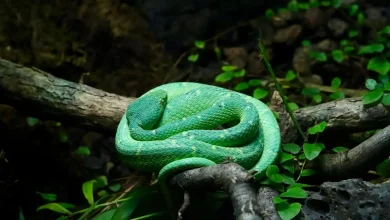
Tropidolaemus wagleri - Wagler's Pit Viper - Dangerous

Tropidolaemus wagleri – Wagler’s Pit Viper – Dangerous

Tropidolaemus wagleri Also called: Wagler’s Pit viper; temple viper; bamboo snake; speckled pit viper.

Thais say: ngoo keow took geh

Length: Average length of 60 cm. Male smaller than female. Female maximum length at 100 cm.

Range: Southern Thailand south of Khao Sok National Park, Suratthani province. Other countries: West Malaysia; Indonesia; Philippines. There is a concentration of them on the island of Phuket, Thailand.

Habitat: Behaviour/habitat: Elevations up to about 1,200 meters but most abundant at elevations up to about 600 meters in lowland primary forest, secondary forest and jungle – especially coastal mangrove. During the day these vipers rest in the trees 2-3 meters off the ground.

Active Time? Mainly nocturnal, but occasionally found during the day, especially during or after rain. Crepuscular in nature, they are more often active during dusk and dawn, or on an unusually dark day during heavy rain.

Food: Birds – especially baby birds in the nest; rodents; lizards; frogs.

Defensive Behavior: Coil back into s-shape and strike. Strike is typically less than .3 meters in distance. Mouth wide open exposing fangs and white tissue. Can strike in succession rather quickly. Their strike is not very fast in comparison with some of the other vipers. The heat-sensing pits between the eyes can sense temperature difference as little as 0.003 degrees Celsius.

Venom Toxicity: Potentially deadly. Strong venom that usually does not result in death to humans. Victims experience a strong burning sensation upon envenomation, and swelling, necrosis of tissue.

Offspring:

Notes: Though these snakes are said to be exclusively arboreal and nocturnal, I found one on a mountain recently during the middle of the day, on the ground, during a rain shower.

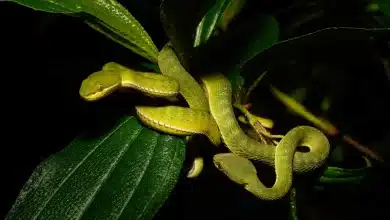
These snakes have a wide variety of colors and patterns.

Tropidolaemus wagleri

Scientific classification

Kingdom: Animalia
Phylum: Chordata
Subphylum: Vertebrata
Class: Reptilia
Order: Squamata
Suborder: Serpentes
Family: Viperidae
Subfamily: Crotalinae
Genus: Tropidolaemus
Species: T. wagleri
Binomial name: Tropidolaemus wagleri

Classified by Boie, in the year 1827.

Top of head – very triangular, and thin neck:

Triangle Head - Wagler's Pit Viper

Video 1 – Wagler’s Pit Viper – found on a mountain in Krabi province, Southern Thailand.

Posted in front-fanged0 Comments

Thailand Snakes Facebook Page – Join Us Over There

Thailand Snakes forum over at Facebook

Thailand Snakes forum over at Facebook

We have a Thailand Snakes Facebook page now. We created the page to make it easier for people to join and post photos and videos, articles that related to Thailand snakes. We have 128 members, but a lot of people in the old Thailand Snakes Forum – are not over there yet.

Here is the URL: http://www.facebook.com/ThailandSnakes

Here is the link: Thailand Snakes Page at Facebook

Posted in Thailand Snake Forum0 Comments

Thailand Snake Stories

Not a new ebook, sorry to say, but just going back and forth with a guy that worked in Thailand a long time ago and wanted to share a couple stories with me. I shared one back. Thought I’d share it with you all. Thanks to Ray for letting me post his emails.

His 1st email to me:

I am not sure this is the place I should be posting this past experience but I wanted to share the past in Thailand with someone. I was in the military from 1971 to 1972 in Thailand and stayed until 1975 as a civilian contractor. I worked on top of Green Hill national park from 1973 to 1974. We would travel 1 hour up to work and 1 hour down every day after a 12 hour shift. We saw many things during our trips to work. Elephants, tigers, wild chickens (fun to catch) and many many snakes. Previously I was at Thakli for over a year and the road kill of snakes at the beginning of the rainy season was common place. Cobras and rock pythons were the largest and flatest. BUT… in the national park, Khao Yai, Khao Keo the books and the statistics did not apply.

One morning on the way to work up the hill the driver slammed on the breaks. What we saw was a Banded Krait crossing the road. My boss said “yell when its tail is at the center line” I did and immediately looked to the left and its head was about a foot past the asphalt. Now this snake was moving really slow with very little bend in its body. Small head and tail with a body that is more of a triangle in the mid portion. And it was FAT. O.K. we were impressed….off to work.

On the way home that evening John, my boss had Lek stop the car at the same point we saw the snake that morning. (understand, I am young and stupid then) I get out of the car and lay down on the road where the snake crossed. I put my toes on the center line of the road..stretched out my arms…and my fingers just touched the edge of the asphaslt. I was and am 5’4″ tall. Do the math and this Banded Krait was over 6 foot long. From what I have read… they only get a little over a meter long.

I know what I saw in a jungle that was basically indisturbed for decades, if not century’s.

My point is that somewhere in this world there are sitll very dangerous animals and creatures that we may never see. And the books are only a guideline.

Thanks for letting me share.

Ray

My response:

Hi Ray,

Thanks for the story. Enjoyed it!

Banded kraits do, occasionally reach 2 meters. I have seen one almost that big, but not quite. Here is my Banded krait page with what I know about them.

http://www.thailandsnakes.com/venomous/banded-krait-venomous-deadly/

You are right, and I’m with you on the fact that what the books say, what the websites say, and what the self-appointed experts say, is just what people have experienced in the past. Two days ago on a hike up a mountain, I found a new species of snake. It’s probably in the keelback family, but there is no such snake classified up to this point in time. I found another new snake near the top of a mountain about 2 years ago too. Nobody had EVER recorded it. So, I’m just one person that found 2 new snakes in the course of looking in Thailand sporadically. There must be dozens more out there that we don’t know about. That’s a cool thought.

Besides that, the general facts in most books are off. What snakes eat… whether diurnal or nocturnal, whether they mate during these months, or others… there is QUITE a bit that is off in the literature. I use books and scientific studies as a guideline, but I don’t believe much of it to be undisputed fact.

Now, here’s a story for you…

It was almost 2 years ago. I took my motorbike up a mountain that few people ever travel up. It was middle of day, about 11:30 AM. I was looking for snakes on the road, crossing the road, and knew I had half a chance to find one, but didn’t really expect to. I just had some time and decided to give it a shot.

I stopped the bike and parked it. I walked up the road, then back… then turned around where I’d just walked from. About 3-4 meters from me was the tail of a snake disappearing into the dense brush on the side of the road. The tail covered the entire lane of the street – same side as me. My brain told me over and over that my eyes were lying to me, and it refused to process the information. What I was looking at was the largest King Cobra tail I’d ever seen… and I’d seen over 100 adult king cobras at the snake farm where I’m a regular, going every couple days in Krabi.

The reason my brain wouldn’t work, is that the tail DWARFED the largest 5.5 meter king cobra tail I’d ever seen. It was double the size of it. It was almost like a dinosaur was disappearing into the brush. My breathing stopped – i literally couldn’t breath because it all was just too much to grasp. There was no way in hell I could have gone into the rubber tree plantation to look for the snake, I was in shock. I did, after a couple minutes of standing there stunned, walk over to the bushes and give a cursory glance in to see if it was visible. That was the extent of it. I was dumbfounded how a king cobra could be that large. Oh, the biggest king cobra ever was 19 feet and some inches, found in Nakhon Si Thammarat province, also in the south of Thailand.

The reason it was so big, is I think, because that mountain is where the guys that catch snakes for the city of krabi- let their snakes go. Rat snakes, cobras, king cobras, kraits, all of them. All of them are food for big king cobras. This king had been feasting for years on easy meals there, and nobody had caught it yet.

When I told king cobra expert, Luke Yeoman’s in the UK, he was as excited as I was. He trusted my judgement. This was a world record king that would have SMASHED the record. He made plans to come over and we were going to track it down using motion-activated cameras and traps. Luke never made the trip because 2 months before he was due to come to Thailand he was bitten on the arm by one of his big king cobras at home in the UK and died within minutes. He’d had a heart attack after the bite, killing him near instantly.

So, yeah, you made a good point… we don’t know what is in the jungles. We haven’t found all of what is there yet. And another thing I learned was to definitely have a camera with me ready to shoot at a moment’s notice – ALWAYS!

You OK with me turning your email and mine into a post for ThailandSnakes.com?

Cheers,

Vern L.

His 2nd email to me:

Vern,

No problem posting anything I share. You have my mind in a rewind mode talking about Cobras.
Same place, Khao yai Thailand , national park, 1973-74. Stopped on the way to work to let the Elephants wake up and proceed up the mountain. Elephant grass to my left. Sitting in the front seat of a Toyota HiAce. Looked left and I was eye level with a Cobra. I have no knowledge what type but I know really BIG when I see it. As stated before, I was young and stupid so I started to move my head back an forth and my new friend followed my every move. I never thought about it for years until I read your email. One more thing about snake size. When I was at Thakli from 1971 to early 1972 we had an incident with one of the drivers that nearly got him fired…until WE appologized for not believing him.

On two occassions just after the New Year Holidays he was late picking up the day shift and claimed he could not pass the road down the hill from the Tropo site because there was a big snake laying accross the road and he did every thing to get it to move (as long as he didn’t have to get out of the truck). We really thought he just over slept in the truck and was full of BS. Now keep in mind there was a tall tail about a giant snake at the Tropo Hill in Thakli Thailand.

Well, just before he pulled another “big Snake and I am late” he got smart and drove back up to the Tropo site, got really indignant (sp) with me and told me to get in the van. …….Bottome line..the Rock Python was stretched completely accross the asphalt road. We could not see his head or tail….and I was not going to get close enough to push him with even a really LONG stick. We threw rocks at it for nearly 5 minutes before it finally moved…very slowly off the road.

I did note that the middle of the snake was at least 10 to 12 inches with a big bulge of about 15 inches past the half way point. I also remember the driver saying the big snakes like the warm asphalt after sunset.

Needless to say, the day shift didn’t want to believe me either until I threatened to get physical. Of course we all got our little Browning cameras ready for the next time….that never came.

Good chatting with you.

Ray

Posted in Thailand Snake Notes0 Comments

New Snake for Thailand, or New Species Found!

I found a snake that appears to have never been found in Thailand before today on my hike at a nearby mountain in Thailand.

Time: 12:10 PM, 4/20/2013

Location: Ngorn Nak Mountain, in Tub Kaak, Krabi province, Thailand.

Elevation: ~ 400 meters.

Weather: 34C. Bright sunshine, though the area the snake was in was shaded by the canopy.

Habitat: Leaf litter right off the main trail. This is a limestone mountain with sand/dirt topsoil. This snake was in an area with no water for 150 meters or so. It was dry in the leaves, but it had rained within the last 2 days there.

Time observing: About one minute before it successfully evaded capture through the bed of leaves.

Morphology: Approximately 70 cm in length. Width of body at the thickest part was about 5.5 cm (diameter). There was little difference in the thickness of the body from the neck down through the body. The tail tapered very gradually, and so was long. The head was about 4.5 cm in diameter. Body of snake was uniform in color, a light yellow – almost mustard color. The neck was slightly red for a length of about 5 cm. Head of the snake was the same mustard color, without dark markings typical of some keelbacks. It had the shape of a keelback head, the eye size was consistent. The head was the same yellow color as the body, and then had a white ring that went from under the jaw, around to the back of the head where it meets the top of the neck. It was a closed loop on the top, though I didn’t see under the jaw. The scales were bright and very clear. The eyes were very clear. I was approximately 60 cm from the snake. It was not in shed. There were 2 small dark dots, no bigger than about 1 mm each on opposite sides of the vertebral column, and these continued the length of the body, stopping at the tail. I could not see the belly of the snake.

Details: I was walking back from the top of the peak and was well under the canopy. On my right I heard a little twitch of an animal in the leaves, just a split-second, and it stopped. I looked down, and very close to my right foot was this beautiful little snake. At first, just looking at the tail, I figured it was a light-colored Rhabdophis subminiatus. When I bent down and took a good look, the body morphology, color, pattern, and head were completely different from any other snake I’ve seen in Thailand. I had a snake bag with me, to carry my water in. I quickly ditched my water and wrapped the bag around my hand and watched the snake for a while, waiting to get a better opportunity to make an attempt to grab it. The snake started moving again, head under the leaves, and then popping it up again where I could see it. I made a grab for the neck, thinking I’d just pin it down in the thick leaf litter and better be able to grab it to put it in the snake bag from there. After my hand came down, it was able to slip out forward, then launch itself over the back of my hand and back down into the leaf litter where it was lost in seconds. I spent 10 minutes looking, and then headed back down the trail, remembering precisely where I saw the snake.

I’ve seen many keelbacks and many other snakes here in Thailand – hundreds. I’ve not seen one of this color or morphology before. When I returned home I promptly checked Google image search for keelbacks, Sibynophis, and other snakes that I thought it could possibly be. I found no images anything like this snake. I checked the “A Photographic Guide to Snakes and Other Reptiles of Thailand and South-East Asia” by Cox et al, and did not find this snake listed.

I think there are dozens of new, never before classified snakes to be found in the mountains of Southern Thailand. Thais are not what I’d consider outdoor types, and there are few people in the country that study snakes to any degree. Fewer still are actively herping during the day or night.

If you are interested in finding new snakes, I do suggest you book your flight to Thailand at your most convenient opportunity, and plan on spending a month or more looking. Give me an email if you are going to be close to Krabi province. Oh, and don’t forget your camera, like I just did!

Cheers,

Vern L.

Posted in snake research0 Comments

Thailand Snakes Forum – at Facebook

Maintaining a separate FORUM for Thailand Snakes has become too much of a time-suck. Forum members couldn’t even post photos of snakes they found in Thailand.

I decided to move everything to Facebook. Most people are on it already, and they have a VERY easy system for uploading photos, videos, or posting comments on anything there. I started posting some photos of snakes there already and we have 60 friends there already.

Please join over there by just clicking the “LIKE” at the top of the page.

THAILAND SNAKES FORUM (click)

Posted in Thailand Snake Forum0 Comments

Blue Necked Keelback Envenomation

Copyright R. Subaraj. Email: serin@swiftech.com.sg

Copyright R. Subaraj.

This is a snake found in deep southern Thailand that I’ve not written anything about, but some conversation last night reminded me to put something about online as a warning to others that might encounter or even keep this snake in captivity.

The Blue-Necked Keelback, Macropisthodon rhodomelas is a small colubrid snake that looks innocuous enough, but is one that has the potential to cause some serious damage. I was reading a scientific paper from a man in Singapore that had one captive, that bit down on his finger and chewed for a bit before releasing him. This 120 kg man (264 lbs) fell to the floor a minute after being bitten by this snake. Here is the complete paper on PDF. It would be great if you’d share this page with anyone that you know who keeps snakes, as this snake is frequently regarded as harmless, like the Rhabdophis subminiatus (Red-necked keelback) once was.

Blue Necked Keelback Paper (click)

Cheers,

Vern

Posted in snake research0 Comments

Herping with Rupert Lewis

Yesterday it rained a bit, and had been raining the previous few days. That would be good for snakes, I thought. It was set to be a near-full moon night, and that wasn’t so great for snakes, but I was eager to get back out to see what I could find. The last time I was out herping was 2-weeks ago. I saw a couple cool snakes, and then while trying to get photos of a Homalopsis buccata I fell backward into the mud and water at the edge of a stream. It was late at night, I was soaking wet, and I had a 15 km motorbike ride home. Not so fun, but definitely funny after I quit swearing at my misfortune (and the broken concrete which sent me over backwards).

I got a message from Rupert Lewis from the UK about herping sometime. He said he’d be staying in Trang, and if I wanted to go out, he’d be keen. I wasn’t keen at first. You know, I get about 5 of these requests per month from people that see ThailandSnakes.com or some of my videos online. I just don’t have time to go out with everyone that writes, but more importantly, it just doesn’t make sense most times.

Though sometimes I’ll go out with someone that doesn’t have a clue about snakes, just to be able to introduce them to snakes and teach them a little of what I know. Usually though, I like to go herping with people that I can learn something from… whatever it is. It might not even be about herping. If someone from Tasmania wrote me (and he already has), and wanted to go out – I’d go in a second. Why? I want to find out about his country, the wildlife, the snakes. If a herpetologist (biologist) or other serious enthusiast with a lot of experience writes – I will usually go out.

Rupert is a 17 year old that appeared to have little experience herping in Thailand or anywhere with venomous snakes. He had a real interest, and I figured I’d go sometime after April when the snake-finding activity picked up a bit, as is usual at that time.

As it turns out he contacted me again recently and would be nearby. He sent me a link to his photos, and I was blown away. He has already, in about 6 months, found MANY Thailand snakes and even some that I’ve not seen here before – 2 cat snakes that I really want to find. (nigriceps and jasperidae (spelling?))

So we met up last night and the kid is brilliant. I’ve seen only two other people know southeast Asia snakes to the level of depth Rupert does, and of course that’s a subjective statement. Suffice to say, he impressed the hell out of me with what he knew. I thought he’d be asking questions like, “what do snakes eat”. Instead, he’s explaining to me the difference between the Malayan Bridle Snake and the juvenile Malayan krait. He is almost an encyclopedia of snake knowledge. It was awesome to spend time with him as we picked each other’s brains about snake habits, appearance, and defensive behavior. We found 5 snakes too – near-full moon be damned.

Rupert wants to make snakes his life… I have no doubt that if he sticks to it, he’ll be THE snake authority in Southeast Asia. He’s a sponge with facts. He knew tiny details about snakes that only someone that lived here or studied the place for years knows.

He may have even found a new species of gecko already – I saw photos.  We walked around until about 1:30 AM and found the Mangrove Cat Snake (B. dendrophila) Puff-faced Water Snake (H. buccata) – three of them, and the ultimate southern Thailand find, or one of them, the Malayan Krait (B. candidus).

Anyway, kudos to Rupert… I do hope he goes far in the field and makes a real difference. If he knows this much at 17, it’s scary to think what he’ll be like in a couple years of living in the region! Scary in a good way.

Cheers Rupert, keep it up man, you’re well on your way.

Vern

Posted in herping snake hunting0 Comments

Mangrove Pit Viper on Koh Samui

Mangrove Pit Viper Snake - Koh Phi Phi Krabi Thailand

This photo comes from a reader that was writing postcards in her bungalow on the island of Koh Phi Phi, in Thailand’s Krabi province when she noticed a Mangrove Pit Viper (Cryptelytrops purpureomaculatus) near her foot!

This is not the snake you want near your foot, as they are heat-sensing, and some are known to be strike-happy.

Luckily she was able to move away in time. This snake is so beautiful. They come in yellow, brown, purple, and black colorations. Awesome to get a photo of this one. Thanks Céline Borel!

Photo 2013 Copyright, Céline Borel.

Posted in front-fanged, thailand readers snake photos0 Comments

Paradise Tree Snake – Chrysopelea paradisi

Brett Ramsay found this amazing snake in a coconut plantation in Khao Lak, Thailand.

Brett Ramsay found this amazing snake in a coconut plantation in Khao Lak, Thailand.

Here is a lovely shot of a Paradise Tree Snake (Chrysopelea paradisi) taken in Khao Lak, Thailand in a coconut grove by a reader, Brett Ramsay. Brett was kind enough to let us publish it here.

The paradise tree snake is virtually the same as the Golden Tree Snake, but there are distinct red or orange scales in a nice pattern on the top of the back and some color on the head. Sometimes the snakes are more green than this one, this snake looks quite black. He also appears to have eaten something, maybe a frog since he is here on the ground.

Click the photo above to enlarge.

Here is our fact page on this snake - Chrysopelea paradisi (click)

Have an image to share? Send it to us and maybe we’ll use it. We’ll credit you with your name, of course.

Cheers,

Vern

Posted in thailand readers snake photos0 Comments

Thailand Snakes at Facebook

I decided to create a Facebook group for Thailand snakes. It is just much easier to get photos up there, and since I haven’t put together a photo database of venomous and non-venomous snakes, I will do it over there because it’s so fast.

Go check it out and “Like” it to join the page and get updates as I put them up.

Currently I’m having difficulty identifying a snake that fell out of a tree and landed on top of a woman here in Thailand. Check out the Facebook page to see it.

Link to Thailand SNAKES at FB – http://www.facebook.com/ThailandSnakes

Cheers,

Vern

Posted in snake-identification0 Comments


Thailand Snakes


Welcome to Thailand Snakes…

Thailand has 200+ snake species with over 60 of them - venomous. I created this site as a way to educate Thais and visitors to Thailand about snakes. Many people kill the snakes they see in Thailand, while in many cases - they are non-venomous and completely harmless. With this site I hope to give people a better idea what is harmful and what isn't.

Browse the many snake photos and videos here so you can identify snakes you see on your porch, in your bed, or underfoot.

If you have been bitten by a snake - go to a hospital FIRST. Don't waste time looking it up on the internet. With some snakes you need to have medical help as fast as possible. With others you have some time. I know a Thai man whose brother died in less than 10 minutes from a snake bite.

There are venomous (some say 'poisonous' erroneously) snakes everywhere in Thailand. Friends have had cobras in their kitchen, and others had kraits in the garage. Vipers love bushes and trees near water and walkways.

Bookmark this site so you can quickly identify snakes you have seen. Notice the variety of venomous and non-venomous snakes in Thailand - and realize that they come in all sizes, shapes, colors, and patterns.

Email - info@thailandsnakes.com

Snake Poll – Survey – Research

What is probably eaten more by Thailand snakes than anything else?

View Results

Loading ... Loading ...

Thailand’s Deadly Snakes